The Geometry of Silence: Five Days on the Kedarkantha Trek
In December 2024, I traded the dense fog of Delhi for the crisp, biting air of the Garhwal Himalayas. I undertook the five day trek with my friend to Kedarkantha summit (12,500 ft).
In our hyper connected world, the most terrifying aspect wasn’t the altitude or the sub zero temperatures; it was the certainty that past the village of Sankri, my phone would become a useless brick of glass and lithium. Five days with zero connectivity. No emails, no weather updates, no infinite social media scroll. What happens when an analytical mind, trained in statistics and mathematics, is abruptly cut off from the data stream and dropped into a stark, indifferent landscape of snow and rock?
It turns out, when the digital noise fades, the world reveals its underlying structure in clearer, often harsher, terms.
The Optimization Problem of Ascent
The trek began through pine forests, the trail already dusted with snow. As a mathematics student, I couldn’t help but view the path not just as scenery, but as a complex optimization problem 🙂. Every step is a real time calculation of energy expenditure versus elevation gain. The trail is rarely linear; it is a continuous series of varying gradients. My body became a machine trying to solve for efficiency on a steep slope. You learn very quickly that the shortest distance between two points (a straight line up) is often the most inefficient path in energy terms. You have to respect the curve, the switchback the geometry dictates your pace.

Statistics of the Sky
Without a weather app to give me a neat percentage chance of precipitation, I was forced back into a primal state of statistical inference. Nature provides a constant stream of raw data, unsupervised. The sampling points were everywhere: the shift in wind direction, the specific density of the clouds gathering over the distant peaks, the temperature drop as the sun dipped behind a ridge.
My brain was furiously performing Bayesian updates. Every new sensory input updated my prior belief about the probability of a snowstorm. It was a stark reminder that statistics began not in spreadsheets, but in survival in the human need to predict uncertain outcomes in a stochastic environment.
The Celestial Dataset
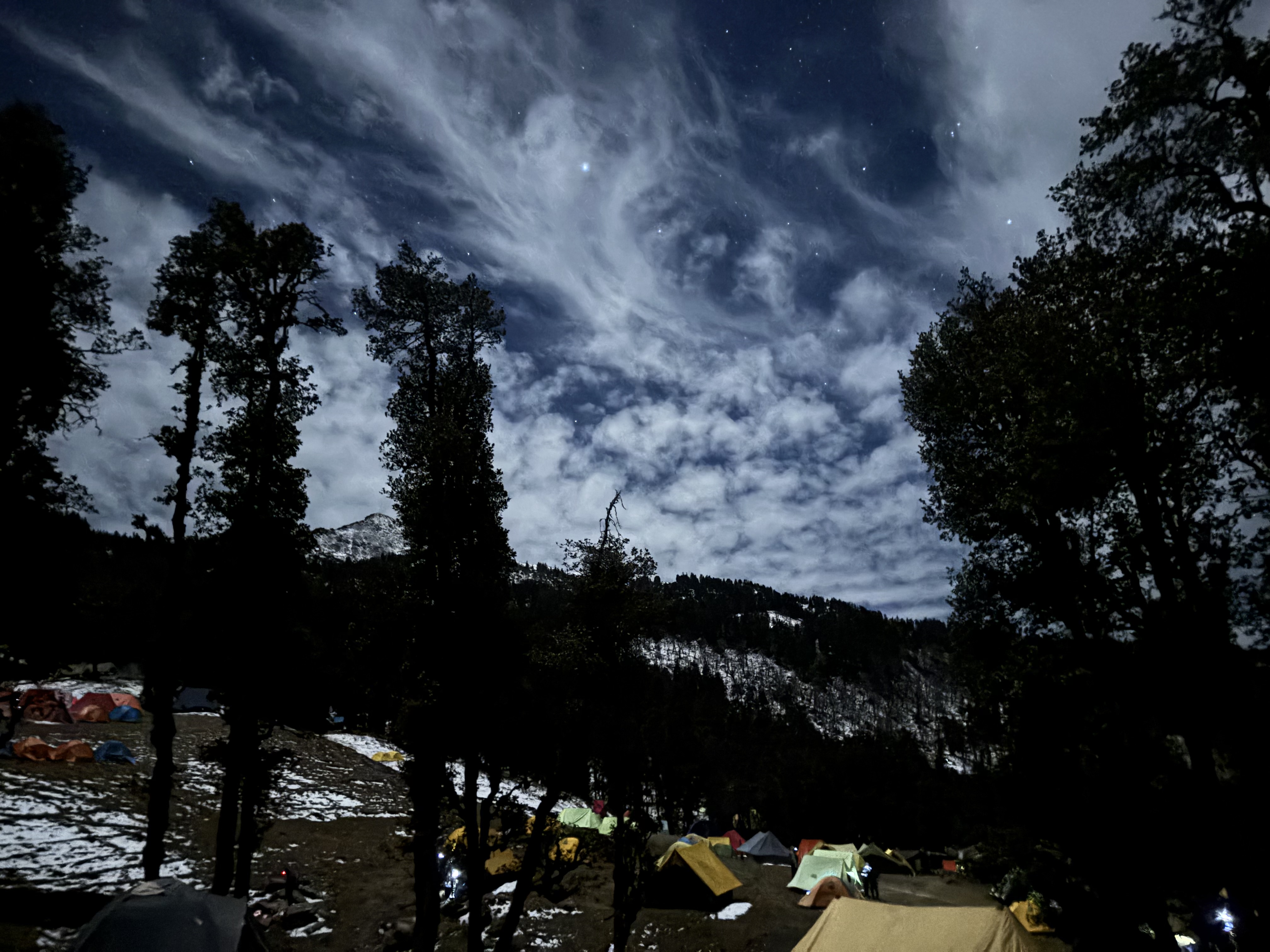
At night, far above the light pollution of the plains, the sky revealed itself not as a void, but as a dense, overwhelming view.
It was a “Starry Night” view, but stripped of Van Gogh’s swirling impressionism and replaced with cold, hard precision. The density of stars felt statistically improbable. Seeing the Milky Way stretch across the horizon was like looking at a high dimensional manifold projected onto a 2D sphere. It is a sight that silences the ego; a reminder that our terrestrial mathematics is just a localized attempt to describe a universally vast system.
The Philosophy of the Summit Push
The summit day started at 2:00 AM in bone chilling darkness. This is where mathematics gives way to philosophy, specifically Stoicism. The physical discomfort of climbing steep inclines in knee deep snow at -10°C is immense. The “why” of it becomes deafening. Why endure this voluntary suffering just to stand on a peak and immediately walk down?
“The struggle itself toward the heights is enough to fill a man’s heart. One must imagine Sisyphus happy.” — Albert Camus
Camus might call it absurd. But in the moment, it felt deeply existential. There is a profound clarity that comes with physical exhaustion in a frozen landscape. You are reduced to the immediate reality of the next breath and the next step. The mountain is indifferent to your struggle; it demands endurance.

Reaching the summit as the sun broke over the Yamunotri and Gangotri ranges was a moment of pure geometric awe. The view is a fractal landscape peaks repeating upon peaks in self similar patterns stretching into infinity. It is a humbling reminder of scale. In the face of such geological vastness, our daily statistical worries seem vanishingly small.
The Zero Data Void
Returning to Sankri after five days felt like waking from a deep meditative state. When my phone finally caught a signal and began buzzing with five days of accumulated notifications, I felt a distinct sense of loss.
The silence of the Kedarkantha had been filled with a richer kind of data the crunch of snow, the rhythm of breath and the undeniable logic of the mountain. It was a powerful reminder that while our models and theorems help us understand the world, sometimes you just have to walk the terrain to truly grasp its reality.
“Two things fill the mind with ever new and increasing admiration and awe, the more often and steadily we reflect upon them: the starry heavens above me and the moral law within me.”
— Immanuel Kant, Critique of Practical Reason
Enjoy Reading This Article?
Here are some more articles you might like to read next: